
Fencing the Grove
Our individual and shared lives together consist of spirit, flesh, and paperwork.
A tree quietly provides for what comes after it: shade it will never sit in, seed and fruit for the generations that follow.
Getting your affairs in order is where we get practical, because life is meant to be far more than a money game, yet our stewardship of what we've been given still matters.
When you prepare for life's inevitabilities with care, you protect and provide for the people you love.
What's possible is the opportunity to love your people well, both now and after you've gone.
So, this page is a starting point. It’s a curated library to help you love your people both now and after you're gone.

End-of-Life Planning
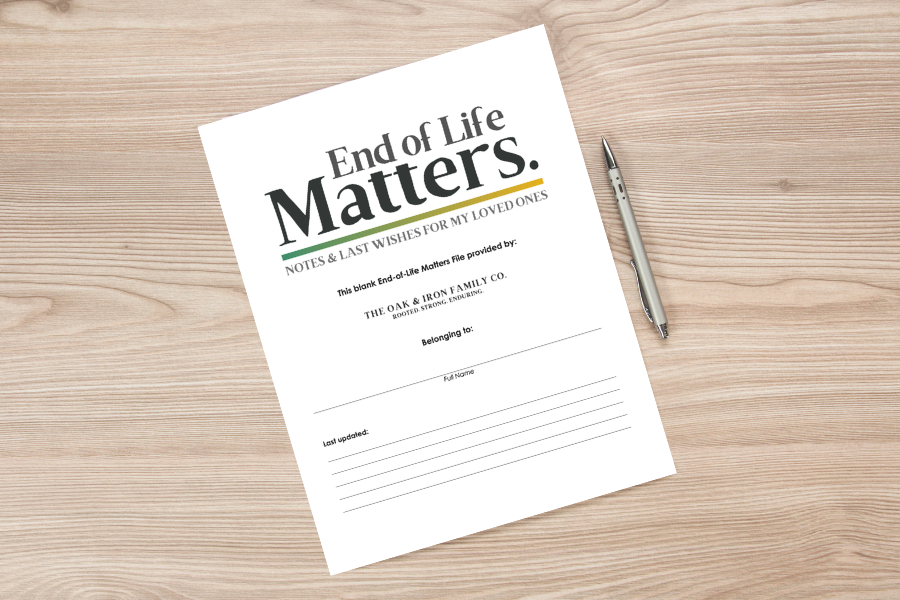
Download our End-of-Life Matters Packet and utilize supplemental guidance for this most delicate process.
-
The Five Invitations — Frank Ostaseki: Drawn from decades of work with the dying and told through his Zen Buddhist contemplative perspective, Ostaseki presents a hard-won practical insight about presence, acceptance and being with suffering. Good for someone wanting a contemplative, hospice-informed perspective rather than a planning checklist.
Being Mortal— Atul Gawande: A physician's honest examination of how modern medicine often fails people at the end of life, and what dignity-centered care can look like instead. Good for someone making medical decisions for an aging parent or themselves and wanting to understand the tradeoffs clearly.
A Beginner's Guide to the End — BJ Miller & Shoshana Berger: A practical, compassionate handbook covering the logistics and emotional realities of dying well. Good for someone who wants concrete guidance on what actually needs to be done, not just philosophy. This is a very practical, approachable resource.
Dust to Dust — Jen Wilkin: Explores what Scripture teaches about death, grief, resurrection, and the hope of eternal life. It is especially valuable for those seeking to better understand God's purposes in life and death, process loss through the lens of the gospel, or cultivate an eternal perspective while preparing for the future.
This is what our society gets so tragically wrong. You shouldn’t leave settling your own affairs to your family. Facing our own mortality is disorienting, but preparing for it thoughtfully turns fear into clarity and gives your loved ones the chance to walk through it with peace instead of panic. Planning for the end is a way you can love your people both now and after you’ve gone.
Legal Affairs
We all have the right intentions and we certainly work to hard to save something to leave behind, but without the right legal structures in place, even loving families can face confusion, conflict, or unnecessary loss when the time comes to act.
-
Entrusted: Building a Legacy That Lasts — David R. York & Andrew L. Howell: Lays out an "Entrusted Planning" process that aligns a family's principles and values with their tangible assets, preparing future generations to build a lasting legacy rather than just receive one. Good for a family with meaningful assets who wants to pass down character, purpose, and stewardship alongside, or perhaps even more than, the money itself.
Beyond the Grave — Jeffrey Condon: A guide to how inheritance decisions can unintentionally create family conflict, and how to structure an estate plan to prevent it. Good for a parent worried about sibling conflict or fairness disputes after they're gone.
Splitting Heirs — Ron Blue: A biblically grounded argument for thinking carefully about how inheritance affects children's character, not just their bank accounts. Good for a parent wondering whether leaving significant wealth will help or harm their kids.
Family Trusts — Hartley Goldstone, James E. Hughes Jr, & Keith Whitaker: Written as a guide for families like the Rockefellers with actively managed, large trusts, this book focuses on how to structure and communicate about trusts so they strengthen rather than strain family relationships. Good for a family setting up or already managing a trust who wants to avoid the common relational pitfalls. Not all of the lessons may be relevant, but there’s much that can be gleaned from this read for any family to better setup and manage a trust.
Financial Affairs
Money is a tool for stewardship, not the measure of a life well-lived. This category is about handling finances with wisdom, generosity, and an eye toward what actually matters.
-
Good Money: Six Steps to Building a Financial Life with Purpose — John Coleman: Steps back from treating wealth as the ultimate goal and instead presents a six-part framework for using money as a tool to build a life of purpose, impact, and fulfillment. Good for someone who's financially successful but unsatisfied, wanting to move past default "save more, spend less" advice toward a deeper relationship with money.
Die With Zero— Bill Perkins: Makes the case for intentionally spending down wealth during your lifetime to maximize life experiences rather than over-saving for a future you may not reach. Good for someone who over-prioritizes saving and needs permission to actually use their resources now.
The Treasure Principle — Randy Alcorn: A short, faith-based case for generosity as the wisest use of wealth, framed around eternal rather than earthly returns. Good for someone wanting a values or generosity lens on money rather than a technical planning guide.
Managing Your Home
A home is more than a household to run, it's an environment that shapes the people living in it and worth managing with the same intention you'd give anything else that matters.
-
The Tech-Wise Family — Andy Crouch: A framework for putting technology in its proper place in the home so it serves the family's character and relationships instead of dominating them. Good for a parent feeling like screens have quietly taken over family life and wanting a values-based reset.
Joyful: The Surprising Power of Ordinary Things to Create Extraordinary Happiness — Ingrid Fetell Lee: Draws on design research and neuroscience to show how small, intentional changes to color, light, and physical space can meaningfully boost mood and well-being. Good for a family wanting to make their home not just simplified or tech-wise, but genuinely delightful to live in.
7: An Experimental Mutiny Against Excess — Jen Hatmaker: Chronicles a year-long experiment eliminating excess across seven areas of life (food, clothes, spending, media, and more) to confront the author's own comfort and consumerism from a Christian perspective. Good for a family feeling weighed down by clutter, consumption, or busyness who wants a candid, faith-rooted account of intentionally simplifying.
The More of Less — Joshua Becker: A practical case for minimalism as a way to create more space, time, and peace at home. Good for a family feeling overwhelmed by clutter or overcommitment who wants a simpler, more intentional household.