
Eat Move Sleep: Maintaining Your Foundation
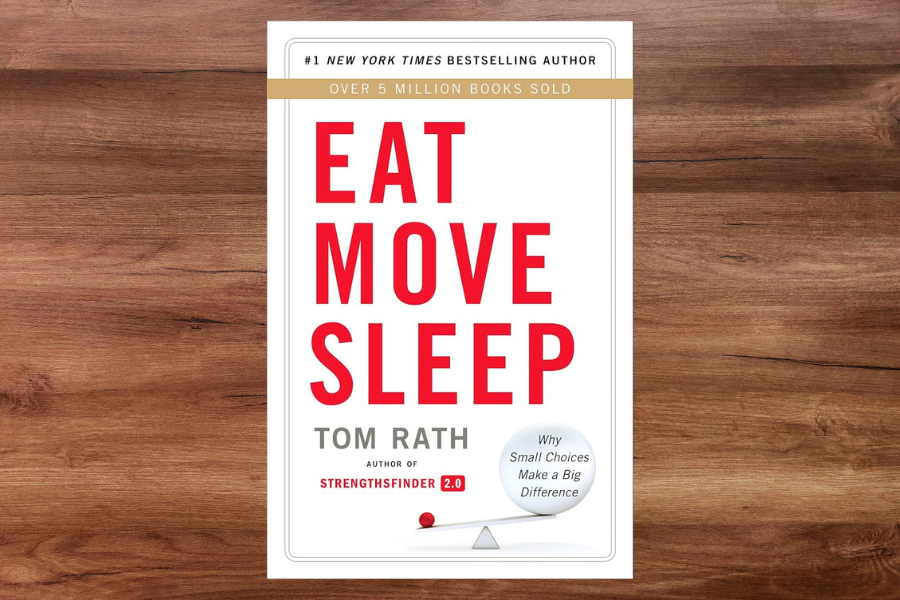
We're excited to introduce you to a book we're so glad to have found. For anyone wanting to improve their relationships, productivity, or overall experience of life, your health is the foundation that will supply the energy and longevity you need to build the life you desire.
Eat Move Sleep is one common sense, comprehensive book you could benefit from greatly. The book is written by Tom Rath, who is no nutritionist or doctor, but a fantastic scientist, researcher and author with Gallup, Inc. This book was a deeply personal endeavor for him as he wrote it while on sabbatical in response to his own life-threatening genetic disorder, VHL disease, which makes him highly susceptible to cancer growth. Instead of giving himself over to fretting how the multiple tumors throughout his body could one day take his life, he dedicated himself to learning what's in his control to slow the process.
He says, "As each year goes by, I learn more about how I can eat, move, and sleep to improve my chances of living a long and healthy life. Then I apply what I learn to make better choices. I act as if my life depends on each decision. Because it does."
Wow. If you're looking for an author you can trust who's not just selling a single far-out, unsubstantiated revolutionary health claim, Tom is your guy.
And the thesis of his book is kindly provided right there in the title. Thank you, Tom! He makes the point that health is the result of how you eat, move and sleep combined daily. The book comprises 30 concise, but well-researched chapters designed to result in 30 Days to Better Decisions.
Here are three of our favorite sections of the book you might benefit from:
"Forget Fad Diets, Forever." Rath stresses quality food matters far more than quantity or caloric intake. Here's his simple advice: avoid anything fried, consume fewer refined carbohydrates, and eat as little added sugar as possible — set your sights on foods that are good for your near-term energy and long-term health, understanding that the body takes a long time to react to dietary changes, usually a year or more.
"Measuring Makes You Move More." Rath says one little secret of medicine and social science is how measurement itself creates improvement — when researchers study the effect of a given intervention, simply asking people to track a specific outcome makes it more likely to improve.
"Sleeping in Only Sounds Good." Rath explains that each organ has its own circadian clock genes that help you operate with efficiency all day long, and one easy way to keep your clock on track is to wake up at the same time each day. Maintaining a consistent waking range every day of the week makes you less likely to shift your circadian clock and get out of sync.
If these are helpful tips, but you're not really interested in reading the book, here's our point for you: there are foundational components of how we live our daily lives that have a massive impact on our lived experience and capacity to give our effort where it matters. How you eat, move and sleep on a daily basis are all critical parts of that foundation you set for yourself. We'd also add connection and solitude to round it up to five foundational components of daily life to maintain health, vitality, and impact.
In coaching, I often walked clients back from their stated goals to help them take inventory of the foundation they'd use to support their efforts.
One Last Note on Your Foundation
We pull the foundation wisdom from that of Jesus who, in the Sermon on the Mount, spoke of his teaching as the ultimate firm foundation for us to build our identity and efforts upon. Speaking of Jesus, you may have noticed religious or spiritual activity appears to be missing from the five foundational components above. While we respectfully refrain from telling you what to believe, let us speak to that for a moment.
What you believe about God and the state of your soul informs how you live your life. There's no way around the reality that all theology is practical and all practice is theological. What we believe about God and the state of our souls informs all we do.
We simply can't add religious or spiritual practice as a category to this list of foundational components, because your philosophy of life (your deepest held beliefs, convictions, commitments, and questions about your existence) is the deepest foundation of your identity, interwoven into how you do all that you do.
The resulting lens through which you see your life underpins your approach toward the life you're living, the hope you have for the future, and the way you go about the five foundational components suggested above.
So we'd encourage you to go even deeper than the five foundations, all the way down to your beliefs. Be gracious and patient with yourself. We're all on a journey. But consider how your beliefs and philosophy of life are serving as a foundation for the life you're building before getting too far into the vision casting, goal setting, and strategizing — especially if you want sustainable progress that comes as an authentic expression of who you are, and not from a fleeting chasing after the winds of success that can lead you to compromising who you are. A friend once shared a line with us worth sitting with: "It's best to let your values shape your goals and not rely on your goals to shape your values."
None of this is easy work, but we hope this gives you some direction. You can read Eat Move Sleep, or simply take these foundation components, adjust them as you like, and start writing your own list of foundational components to begin integrating into your life.